
The Saga Continues
Chapter Seven of Blood Lies, Book One of The Redwing Saga

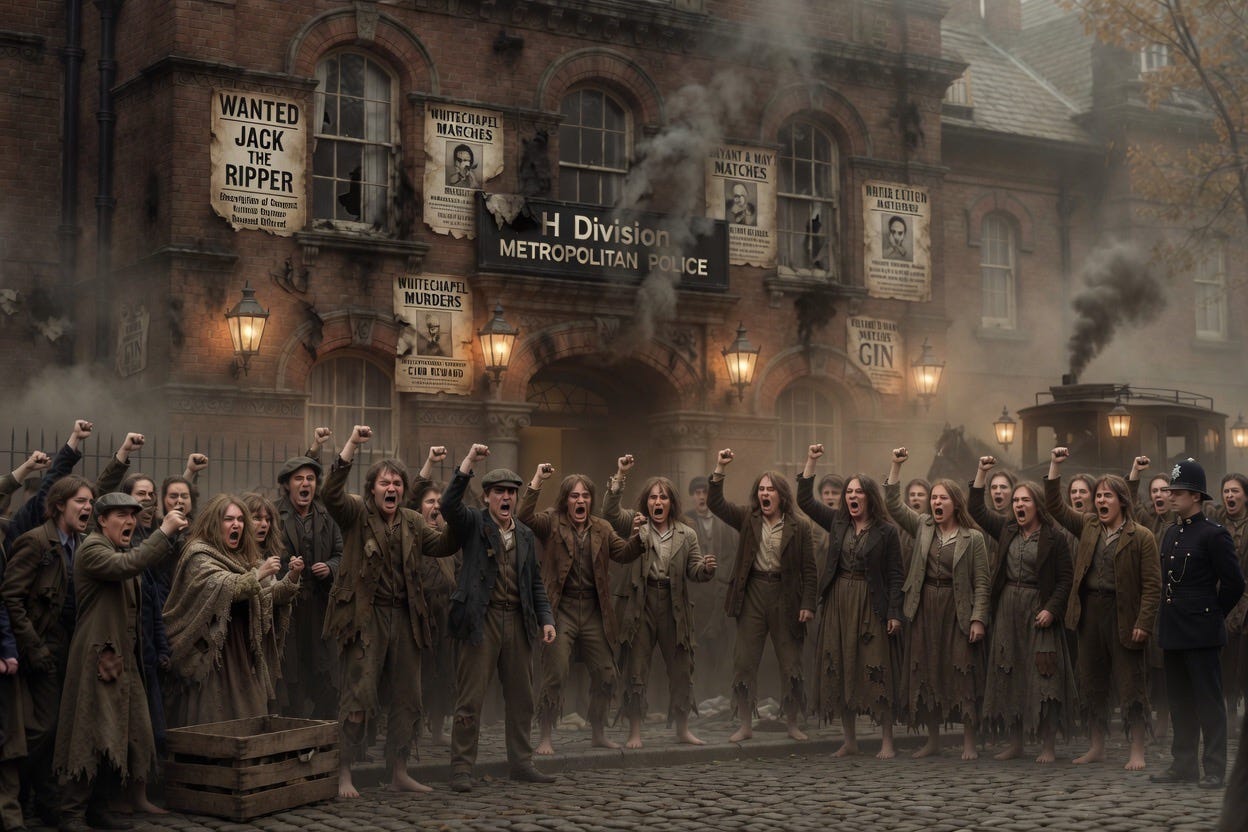
An angry mob demands justice for Ripper Victims outside Leman St. Police Station
CHAPTER SEVEN
6, October
Leman Street, even on a quiet day, could be a raucous and very dangerous avenue on which to travel, but this day—two days after the first phase of the Catherine Eddowes inquest, one day after the sudden adjournment of the Liz Stride inquest (postponed now until the 23rd) and the very day of Stride’s burial—the citizenry of Whitechapel were enraged by what they perceived as deliberate mishandling by the police. In response, some men formed committees whilst others merged organically into murderous mobs, as if driven by an unseen spiritual leader, and the east end parishes rose up into a maddened riot with revenge and blood on their minds, and some even called for revolution and anarchy.
Street women who plied their trade in alleyways and crosscut rookeries had all but shut up shop, excepting those who dared not for want of bed and breakfast, and many of those terrified women now hurled accusations if not actual stones at the men in blue. The dusty sidewalk and muck-stained cobbles in front of the doors of H-Division teemed with overworked police constables holding back a mob of strumpets, ironworkers, hauliers, bakers, beggars, costermongers, and honest merchants from across the east end. But amongst their number circulated a political patchwork of university-educated anarchists, Bohemian protesters, militant suffragettes, writers, artists, news reporters, and opportunistic trade union rioters; a melee of humanity, choosing sides and vowing vengeance for the women whose names most had never even heard spoken before the Ripper began his dark work in the impoverished east end streets.
Inspector Edmund John James Reid was a short, stout man with an iron face and close-set eyes. Beside him, and several inches the taller man, stood a gruff individual who looked more like a banker than a police detective. Inspector 1stClass Frederick George Abberline, Edmund Reid’s superior within CID, had been assigned to oversee the Ripper investigation, and as the colourful inspector often phrased it, was currently appointed as ‘head zookeeper’ at the Leman Street police station. Since the murders began, both men had racked their brains to decipher any clues left behind, only to be stymied by decisions ‘up top’ at the Yard by Police Commissioner Sir Charles Warren, or worse by Parliamentary muckabouts using the murders to advance their own political ambitions.
Neither man had slept well in recent weeks, but both stood now alongside their men, billy clubs in hand. The club was a one-foot-long wooden truncheon able to inflict severe pain to a shin, a shoulder, or a back in the practised hands of the division’s well-trained men, and Abberline and Reid had many years of such practise between them.
It was nearing noon, and the sun stood directly overhead, illuminating the crowd and overheating the rabble who often wore an entire wardrobe upon their scrawny backs for lack of any permanent place to live. Michael O’Brien, a noisome reporter for The Star, took copious notes of the protest whilst his co-worker, American-born Harry Dam, snapped photographs using an expensive Kodak No. 1 box camera.
Reid shouted for both men to move. “O’Brien, you and Mr. Dam will withdraw your fancy boots from this sidewalk, or I shall find myself in possession of a very fine camera, and the two of you will spend a night in my cells!”
O’Brien, a slender man of thirty with sandy hair, stepped backward several steps until his feet touched the cobbles. “I stand upon public property, Inspector Reid. Shall I mention your threats in my article alongside one of my colleague’s fine photographs?”
Reid sighed, advancing slightly toward the reporter. “Shall I introduce your wrists to a set of iron bracelets, Michael? Or do you prefer to rephrase that?”
O’Brien smiled and waved to two other detectives who now watched from within the police station facility. “Good day to you as well, Superintendent St. Clair!” he called. “Have you a quote for The Star? A comment on your recent investigations? Your trips to a certain fashionable address in Westminster, perhaps?”
Charles St. Clair turned his back to the glass and continued to sip his coffee. “France, tell me when that hellish man is gone. Else I shall have to kill him.”
Inspector Arthur France, who had served with H-Division since before the ‘duchess murder’, as the Scotland Yard insiders called it, stood beside his superior, just inside the doorway by a large mullioned window. “Do you think he followed you to her house, sir?”
“I think T.P. O’Connor’s minions would do anything to uncover a salacious story and sell newspapers. And when they lack for evidence, they merely manufacture it.”
Charles feared his visit to Queen Anne House had been observed, but if not already known, it would only be a matter of time. He’d shared some of the visit’s details with his friend Arthur France, but certainly not all. With Ripper madness providing the public with a steady diet of sensationalism, hints and accusations against anyone from Scotland Yard—particularly one connected with peerage houses—could add thousands of new subscribers to The Star’s ledgers, and St. Clair had no wish to involve the duchess in such libelous muckraking.
“I imagine O’Brien’s American friend has already photographed me,” St. Clair remarked.
“Many times, sir. Those cameras cost half a year’s wages, I’m told. Oh, but look, sir. Isn’t that Ida Ross? The one who used to work across from your house?”
St. Clair turned back toward the window, his blue eyes narrowing. “It is. Don’t tell me she’s been beaten again. France, could you ask one of your men to help her inside? If Lusk’s crowd sees her, they’re sure to bring her even more harm. That man may claim to be a champion of the downtrodden, but he’d happily trod upon her, if it suited his ambitions.”
France tapped a police constable on the arm. “Rickets, see to it that Miss Ross makes it through our doors safely.”
The young police constable nodded and left to escort the prostitute indoors. In a moment, the thin woman stood near the sergeant’s booking desk, trembling with fear. “Mr. France, sir. Thank you, sir, for your help. I wonder, is Superintendent St. Clair here today? I stopped by his house, and Mrs. Wilsham told me he might be here, on account o’ the protest an’ all.”
The superintendent left his lookout spot near the window and gently took the young woman’s emaciated arm, leading her away from the desk. “Miss Ross, you need a doctor.”
She shook her head. “Nah, sir. I ain’ got no money for such. I’ll be all right. I just come in to tell ya that there’s been a man at your ‘ouse, sir. Funny lookin’ gent, an’ he’s been writin’ stuff in a book. Reporter, I reckon. Oh, and...and...” she started to say, but her eyes rolled up in her head, and she fell forward into the detective’s arms.
“France! A little help!” he cried, lifting the frail woman up and carrying her into the main parlour of the station house lobby as France held open the door. “Fetch Dr. Sunders, if he’s here.”
France sent Rickets to bring the physician from his work in the morgue, and Charles poured cool water on a linen towel, using it to wipe her forehead and cheeks. The woman’s face was gaunt—thinner than the last time he had seen her, and her eyes were rimmed in dark circles and ugly bruises.
Sunders arrived in shirtsleeves, and he knelt beside the unconscious prostitute. “She’s in bad shape,” he said bluntly. “He may have killed her this time. Poor girl.”
“She told me she’d left him,” St. Clair said softly. “Sunders, can we get her to the Eastern Dispensary?”
“Perhaps. I can take her over, Superintendent. Why on earth do these girls keep returning to the men who knock them about?”
“I cannot say,” Charles replied as France joined him.
“Sir, it’s Lusk. He’s making threats again—saying he’ll start arresting any and all the Jews of the city who even look at a woman.”
“Will he now?” St. Clair said, rising from the chair. “I imagine Reid and Abberline can handle it, but let’s go see if they require our help. Some days, France, it doesn’t pay to leave Whitehall.”
“I suppose that’s the price one pays for being overseer for the east end, sir,” Arthur France replied, as the pair walked back to the large window, where they could see a thick group of outraged citizens standing toe to toe with the two overworked police detectives. “Shall we stop it, sir? Lusk and his crew, I mean. He’s about to give Mr. Abberline a clattering, it looks like. Lusk thinks he’s right smart.”
“Yes, well, it looks like Abberline’s not lost his persuasive ways,” St. Clair noted proudly. A fracas had broken out near the sidewalk between Michael O’Brien and several rough looking men from the Vigilance Committee, but Fred Abberline’s mutton-chop face spat orders at the builder, making it clear that his interference was neither wanted nor needed.
George Aken Lusk and his rabble-rousing vigilantes had gained ground and support the past few weeks, and it seemed to France that they had also gained financial backing, for many of the men had foresworn their day labour jobs in favour of protesting—most working on the new, construction projects near the river basin under the banner of Sir Clive Urquhart’s fashionable company, Urquhart Investment Group. France had mentioned this to Superintendent St. Clair two days past, and he now said as much again in conversation.
“I just wonder who’s paying Lusk’s bills,” the young man said to the superintendent. “Must be nice to spend an entire week off the job and still have a bob or two in your pocket. And he’s wearing a new hat, or my name’s Plum.”
“You know, I think you’re right, Arthur. It’s worth looking into,” St. Clair replied. “See what you can discover along those lines and get back to me. If Lusk is in the pay of someone who benefits by the fomenting of violence in Whitechapel, then I want to know that man’s name. I’d certainly like to find just cause to arrest Lusk, wouldn’t you, France?”
“I pray for it each morning, sir,” the younger man said.
St. Clair stepped closer to the glass and watched Reid and Abberline with a certain pride. “I’ll wager those two would love it if Lusk and his lot did try to penetrate the station house. Reid especially. He’s a scrapper for a runt.”
France sipped Turkish coffee from a stoneware mug. “He is at that, sir. I’ll fetch two clubs from the armament cabinet, just as a precaution.”
“Good idea, but once done I may need to leave for an hour. Miss Ross mentioned seeing a man near my house. She thought him a reporter. I want to make sure Mary’s all right. I’d hate to think some of this riff-raff have moved up to Columbia Road.”
“I could go, sir, if you prefer to remain here. I assume it’s why you joined us today.”
“It is, Arthur. No, I can go there on my own. It shouldn’t take long, and I can have luncheon whilst there. Mary Wilsham’s dear to me, and I’ll not see anyone molest her.”
“Me neither, sir. Blimey, there’s another one!” the young inspector exclaimed. “Toff slummer from the west end most likely here to join the parade. What is it about Jack that brings out these people, sir?”
“I wish I knew, Arthur. Fetch those batons, will you? I want to check on Miss Ross again, and then you and I shall join Reid and Abberline for a little exercise.”
The superintendent made his way through the thick knot of uniformed officers from J and K Divisions who had been brought in to help maintain order. The surrounding cells were filled with drunks and prostitutes, and the station house sounded like a cacophonous representation of Babel.
“Sunders, how does our lady fare?” he asked as he sat into a chair near the narrow couch.
“She’s in very poor condition. I found some medicinal cream in her purse, Mr. St. Clair. A mercury preparation.”
His face fell. “She has syphilis?”
Sunders nodded. “Most likely. It is the bane of such an occupation, is it not, sir?”
“It is. Keep watch on her, will you, Thomas? It looks as if Inspector France and I may need to lend a hand outside, and then afterward, I’ve an errand to run.”
In the lobby behind him, through the connecting door, St. Clair could hear the already riotous station house lobby explode suddenly into auditory anarchy. “What now?” he muttered, recognising O’Brien’s voice amongst the mayhem, apparently shouting questions to someone who had just entered.
“Sounds like trouble,” Sunders said with a wink. “If this continues, you might have need of that pistol you keep disguised under your coat.”
Charles smiled, patting the shoulder holster beneath his jacket. “Now, Sunders, you know that firearms for inspectors and higher are now permitted. I carry it merely as a precaution.” St. Clair rose and headed toward the knot of people who had gathered near the booking sergeant’s desk. O’Brien and Dam hovered at the centre of a dense cluster of reporters and rioters, and betwixt them stood a woman—one who had no business being in Whitechapel.
“Good Lord!” St. Clair cried out, pushing past France into the chattering field of humanity. The woman appeared to be doing her best to answer the reporter’s questions whilst the American photographer snapped photo after photo from a variety of angles.
“And is it true that you returned to England because of these rumours surrounding the murders, Your Grace? Or might there be a more, uh, how shall I say it, personal reason for leaving the pleasant occupations of life in the Parisian countryside?”
Charles reached Elizabeth before she could answer, deftly taking her by the elbow. “Beth, what are you doing here—alone, without an escort?” he whispered.
O’Brien scribbled quickly into the pages of his notebook, and Harry Dam snapped several photographs of the superintendent and the imprudent duchess.
“Superintendent St. Clair, sir,” O’Brien interrupted. “Did we hear you address the duchess by her Christian name? My, but that is quite unusual for a police detective, is it not, sir? Speaking so intimately to a high peeress of the realm. Is the duchess here on business or pleasure, Mr. St. Clair? Would you mind offering a quote for our readers to go along with this touching photograph?”
The detective started to reply, but it was Elizabeth who turned toward the reporter, her dark eyes wide. “Who are you?” she asked plainly, surprising both the reporter and the detective. “Wait, I believe I know. I have seen you before, only yesterday, in fact, skulking about my gardens. A police station may prove a dangerous place for you now, sir, as I imagine that many here would happily remove you and your American friend to a quiet cell, where you may reconsider the propriety of your insinuation.”
“Your Grace, I only meant that...” O’Brien muttered, but Beth stepped toward him, her gloved forefinger denting the reporter’s waistcoat as she spoke.
“You only meant to spark a fire in hopes of igniting a conflagration of new subscribers for your rag of a newspaper, did you not, Mr. O’Brien? Oh, yes, I know your name, and I imagine most of my family also know it. Lord Aubrey, for instance,” she said, her voice lowering to a whisper. “Shall I send for my cousin? I believe his is an acquaintance you have made already, or am I mistaken in that, Mr. O’Brien? He gave you a marvelous quote for your paper last summer, written intractably upon your back, did he not? Or would you rather deal with me? A helpless female peeress, you imagine. I may appear physically helpless, but I wield a mighty club, nonetheless. Shall I prove it by reminding your superior, T.P. O’Connor, that his political ambitions require a constant source of funding?”
Charles had released her elbow, surprised to find Elizabeth so ready and able to defend herself against the merciless hack, but he also knew that the press was but one danger this day, and already several unsavoury types had managed to work their way through to the perimeter of the melee, and St. Clair feared the duchess might be in physical peril.
“Your Grace, will you come with me, please?” he said, once again taking her arm. “Please.”
She turned toward him. “What?” she asked, for the room’s noise level was deafening and the irritating reporter continued to ask questions, his pencil scratching out copious notes in shorthand.
St. Clair shouted to be heard. “You should not here, Duchess! Where is Lord Aubrey? Why is he not with you?”
She shook her head, pointing to her ears, and he wondered if she truly did not understand, or did not wish to.
Harry Dam had maneuvered closer and was clicking his box camera’s shutter over and over, and St. Clair’s frustration level rose higher and higher until, at last, it snapped.
“Enough!” he shouted, jerking the camera from the reporter’s hands. “If you want this back, Dam, then you will remove yourself from this station house now! No more questions. Not even one. Everyone out! Else, I shall have you all arrested!” he shouted.
“On what charge, Superintendent?” Dam asked.
“Vagrancy, assault, annoying an officer of the law, I care not. Just get out before my good humour wears thin!” St. Clair shouted.
As the throng broke apart, Elizabeth’s gaze fell upon the woman in the parlour, and she gasped. “Oh! I know her!” she cried, pushing through the crowd toward Ross.
St. Clair worried that someone might try to rob Elizabeth, or worse harm her, so he waded through the mob and grasped her arm once more. “Beth, please,” he said, but she paid him no heed. “Elizabeth!” he shouted, and suddenly you could hear a pin drop.
She spun toward him, her eyes wide.
“What are you thinking? You cannot just come here as if it’s a pleasant day in St. James’s park!” he shouted so loudly that all within the station house turned to gape at the couple.
France came to his aid, gently touching the enraged superintendent on the arm as if to snap him back to the present. “Sir, she is fine, thanks to your quick intervention. Would it not be wise to remove the good lady to Mr. Reid’s office?”
Seeing Beth amongst such a hive of potentially dangerous men, St. Clair had imagined the worst, and suddenly he began to realise the true depths of his affections for the beautiful peeress. Briefly, he considered sending for Aubrey to escort her to safer ground, but he thought better of it after seeing her eyes. They had grown round with fear—not fear of the crowd, but fear of him.
“Elizabeth, forgive me. France is correct. Please, allow me to take you upstairs to a quiet place. Then you may tell me why it is you have risked your person, if not your life, to come here on a day when Whitechapel is an armed camp.”
She pondered his words for a moment, and it seemed that she felt torn by warring thoughts. “Very well, but Charles, I know that woman.”
“You couldn’t know her, Elizabeth. Now come with me, please.”
“I’m sure I do,” she insisted. “I met her...where was it now?” she began, but suddenly her face paled. “Oh! I remember now! She talked to me that day at your...” All colour drained from her face, and the duchess put her hand on St. Clair’s arm. She leaned forward to whisper. “Ten years ago, at your house,” she said tightly, and she seemed to grow unsteady on her feet.
“That’s it,” St. Clair said, putting an arm around her waist. “In here, quickly.” He pulled her into the parlour, shutting the door and closing all the blinds, so that no one in the crowd might see them.
“Elizabeth, sit down. Now.”
She obeyed, and in a moment France had joined them.
“Sir? Is she all right?”
“I don’t know. Sunders?”
The physician left his current patient and felt the duchess’s pulse. “It races. Madame? Miss? Superintendent, do you know her?”
“Yes, but I prefer this crowd not realise it, though it’s clear that the hacks from The Star already do. Elizabeth, look at me.”
She glanced up, her pupils large. “Charles? I—I felt rather strange for a moment. Have you any water?”
“France?” he asked, and the young inspector fetched a carafe and glass from a small desk in the corner, pouring a large serving and handing it to his superior. Charles held the glass to her lips. “Drink this now, darling,” he said gently. “Not too quickly. There. Is that any better?”
She nodded, fanning herself with her hand. “I grew warm, I imagine.”
Sunders checked her eyes. “Are you prone to spells, Miss?”
“Sometimes,” she replied. “Forgive me. I am better now. Thank you. That woman, though,” she continued, pointing to Ross, who still lay unconscious. “I do remember her, Charles. I saw her...”
“Not here, Elizabeth. I’d prefer we speak of this elsewhere. Do you feel well enough to climb the stairs?”
“Yes, I imagine so.”
He helped her to stand, and she seemed somewhat unsteady still. “Lean on me. We’ll have to traverse the crowd once again, but only for a moment. We can take the back flight to the next floor. You are sure you’re able?”
“If you are there, yes. I can do it.” She looked toward the physician. “Are you the police surgeon?”
Sunders nodded. “I work at J-Division most days, but I was called over to help out on a case. Have you been ill, Miss?”
“No, not of late.” She reached into her handbag and withdrew a small gold case. Opening it, she took out a calling card and handed it to the doctor, who read it and whistled.
“You are the Duchess of Branham?” he mouthed, instantly realising why St. Clair wished to remove her from the crowd. “Forgive me, Your Grace. It isn’t often I meet a duchess, particularly whilst in a police station.”
She smiled. “You are very kind to say so. Would you do all you can for this woman, please, Doctor? And if there is need for payment—of any amount—have the bills sent to me.”
Sunders looked at the superintendent. “Sir?”
“It’s all right, Sunders. If she desires it, then do it. Beth, that is not necessary.”
“It is, Charles. It is. Now, I shall follow as you lead.”
They returned to the lobby, where St. Clair handed the box camera to the desk sergeant. “Put this somewhere safe, and do not return it to Dam without first removing the film roll.”
As they climbed the back staircase, Elizabeth thought of Paul Stuart, recalling his face when she’d accepted his ring and his trust in her promise. Why did she insist on caring for this policeman?
“In here, Miss,” France said, deliberately avoiding all reference to her station in life, even though he had immediately recognised the child’s face in that of the woman. Once the door had shut, the young officer looked to his superior and pointed toward the lower level.
“Best no one else down there realises who she is, I think, sir; though it’s still likely to be all over this afternoon’s front pages. Course, now they’ll have no photographs to prove it,” he said to St. Clair. Then to the duchess, he bowed. “Your Grace, if you will forgive any familiarity. I knew you as a child, when sad circumstances, which I shall not repeat, brought you to our station house. It is an honour and a great pleasure to see you again.”
Elizabeth’s worried expression vanished in light of this simple speech, and she put out her gloved hand to shake his. “It is I who must ask your forgiveness, Inspector France. It is Detective Inspector now, I’m told. You were but a Police Constable ten years ago, and you did much to ease my heart and make me feel safe. You have done well. No, gentlemen, I did not think. I merely acted without considering what strains your station house must now be under. Charles, please, forgive me,” she continued, her eyes downcast as she remembered his passionate kisses. “I have frightened and worried you both. It is only that I have received something that I thought I ought to bring to you at once. It is a letter. And it is signed by someone you and this quarter know all too well.”
St. Clair had noticed her demure glance, and he wondered if she now regretted their intimate moments four days previously. Wishing they had more privacy now, he took the white envelope she offered. “You handled yourself rather well downstairs, Duchess. I believe O’Brien and Dam will be tending their wounded pride for many days, but France is right. The story is likely to make today’s press, which will then bring a flurry of reporters to your door.”
“So long as you are there to help shoo them away,” she said, smiling at last. “Charles, this letter. Please, look at it. It is important.”
St. Clair turned his attention to the envelope. It was addressed on the outside in a flourished hand using crimson ink that sent a chill down his spine. The address read, ‘To the Duchess, Queen Anne House, London – for her Eyes only’.
“Does this strike as familiar, France?” he asked.
The young inspector nodded. “It does, and it is with no great happiness that I say it, sir. This came to you, Your Grace?”
“Yes, it did, Inspector. Read it, Charles. Please.”
St. Clair opened the envelope.
Inside, a single sheet of cream notepaper bled with the same red ink. The hastily scrawled words read:
Dear Duchess,
Think you’ve escaped old Jack’s long arms? Not yet, my sweet girl. My knife may have missed you ten years ago, but it bit into your pretty mother’s white flesh over and over again. I am saving something special for your tender body. Something tasty. And I shall get ‘round to it—very soon.
Your crimson knight,
Saucy Jack
“That damnable devil! How dare he do this?!” St. Clair shouted, and he slammed the note down onto the desk with such fury that the blow knocked several pens and a bottle of ink off their mounting, spilling the ink like so much black blood across Edmund Reid’s blotter. Elizabeth jumped at the sound, her dark eyes rounding in surprise.
France hastily daubed at the spill with his handkerchief, staining his hands and trying not to stain his clothing. “I’ll fetch some ink remover from the sergeant’s desk, shall I, sir?” he offered, realising St. Clair would probably prefer a moment alone to calm the duchess—and himself. Softly closing the door behind him, France made his way down the steps, but he could still hear St. Clair’s outrage even on the ground floor.
“This beast dares to use such words—such threats! How dare he send these horrid lines to you? To you! And to invoke your mother, when he had nothing to do with it is maddening! How can he even begin to think that…wait. Wait a moment. How can he…?”
His stream of words slowed as his mind digested the implied truth concealed within the taunting message. At last, he grasped what the duchess had already surmised, noticing only then that she had gripped his arm tightly. “Beth, how does this man know that your mother was murdered in Whitechapel?” he finished.
“Precisely,” she whispered tensely. “How does he know? If this Ripper madman is nothing more than one or even a group of vile men who hate women, then how does he know about a case that, to my knowledge, has been all but erased from the official police record? Yes, I know about your secret activities on my behalf with Lord Aubrey. He confessed as much to me last summer. Charles, I know that you and Paul removed the evidence regarding my mother’s death so that I might be free from it and would never find her broken body on display in the exhibits of some tawdry wax museum or splashed in ink across the pages of The Star, but clearly this fiend knows all! But here is what is worse, my dear friend, and it is why I so impulsively rushed here today when I learnt you were in Whitechapel. This letter did not arrive in the post, as you can see, for it bears no stamp. Yet, it was found in our post bag this morning.”
St. Clair felt a massive wave of dread creep into his stomach, as if something far more sinister loomed on the horizon. “He had access to the postman’s bag before it arrived?” he suggested.
Elizabeth shook her head. “No. I sent to the post office and asked our postman to come by again, and he did so at ten this morning. He said no such letter was in the bag he left with us.”
He smiled for a moment, remembering the girl who had investigated the publican on her own. “So you have already begun to inquire about the envelope, have you? Shall I issue you a warrant card, Duchess?”
She returned his smile, and it helped to ease the tension. “Not just yet. Perhaps another time.”
“And your postman is reliable? Do you know him well?”
“Yes, Mr. Hampton is a very trustworthy gentleman whom I’ve known for many years, and he was kind enough to circle back on his route and submit to my questions—even though I lack a warrant card,” she added, smiling once more. “I imagine you think me foolish, but I merely wished to know more before... Well, before imposing on you and your office.”
“I would never think you foolish, Beth, but you could have sent one of your footmen to A-Division,” he suggested. “Though, since this is H-Division’s case, I imagine that is why you brought it here.”
“You tease me now,” she complained, and he feared he had hurt her.
“No, no, Beth, truly, that was not my intent. Forgive me. Of course, I am glad you brought it to me. It is just that today—well, no matter. So, this Hampton fellow, did he recall seeing the letter?”
She shook her head. “No. He had filled the bag himself, and he would have remembered such an unusual envelope. Our house is the first stop on his morning route, and he met no one along the way, therefore it was not surreptitiously slipped into the bag. I was quite clear about asking him this. It can only have been placed into the bag after Mr. Hampton left it with my butler, which must mean that someone had access to the house.”
Panic again seized him as he realised what this implied. “Which also means he has access to you. No, this will not happen. I shall shoot this Saucy Jack person myself, if it comes to that, no matter what the law might say. Elizabeth, I’m sending for Lord Aubrey. I want him to take you to Scotland right away.”
“No, Charles,” she replied stubbornly. “Please, don’t. I will not leave—not yet. I need to make you see how far this plan goes, so that you realise the deep history of it, the true evil of it. Ripper and his crimes are but one aspect to this madness. I must show you the tunnels beneath Branham.”
“Paul can show them to me after he leaves you at your grandfather’s estate.”
She shook her head. “That would not work. Paul has seen parts of the tunnel system, but I have never shared these areas with him.”
St. Clair sighed, for he could see no other option. “Very well, but we will go together to Branham, the three of us, as soon as we may. But for now, today, I want you in Aubrey’s protection. I will not have you remain at a house where a madman lies in wait. France! Come up here at once!” he called into the stairwell. “I’ll send Inspector France with a message to Whitehall. I take it the earl is there today?”
“I believe he is,” she replied, resigned to her fate. “Forgive me for worrying you, Charles. Had I known the pressures you are under today, I would not have come, but instead gone to Superintendent Dunlap at A-Division as you said I should. But I thought you would wish to see the letter. Forgive me, please. It’s clear that I’ve upset you for no reason.”
He pulled her into his arms, not caring if anyone else in the station saw. “Forgive you for what? For coming to me when you feared? For asking me to share your danger? For seeking my aid? I would be upset and angry had you not done so, Elizabeth.”
“Charles,” she began, but he put two fingers on her lips to quieten her.
“Listen to me for a moment, my darling, beautiful duchess. I know you cannot tell me all that now worries and haunts you, but if you will allow it, I shall take that worry upon myself and remove all that makes you afraid. All that terrifies you. Will you allow it, my dearest heart? Will you let me be your protector...if not...more?”
She thought about Paul’s proposal, of the ring now upon her left hand, beneath her glove. How could she hurt him?
“I want to...I do, Charles, for it seems that my fears vanish whenever you are near.” She clung to him, her mind racing to all possibilities and how each would affect her family, but her heart won out at last, and she looked into his eyes, her own filled with trust. “Oh, my noble knight, yes. Yes, I will, Captain,” she said, knowing she risked forever damaging her relationship with her wonderful cousin, but her heart needed to look to Charles, though she wished it did not.
St. Clair kissed her cheek and then her hands, longing to do more. “Good, then it is settled. Once Aubrey arrives, we shall make plans to go to Branham.”
“If you say that is how it must proceed, then I accept it,” she whispered, sitting on the sofa. “Charles, why did you not wish for me to speak with that woman downstairs? I am not mistaken. I did recognise her.”
He’d wanted to avoid this conversation, but it appeared inevitable. “I’d rather hoped you wouldn’t recognise her. I saw how it affected you, Elizabeth. Those old memories came flooding back along with that recognition, did they not?”
She looked away, suddenly realising where they now sat. “It was this office, wasn’t it?” she asked. “Here, where I was brought that night. Where...”
“Please, don’t think on it, darling,” he whispered, sitting beside her. “Let the past remain buried.”
She leaned into his embrace. “If only it would, Charles. I fear that the old memories do not remain buried for long. But that woman. She talked to me. That day at your house. She knocked on the door.”
St. Clair blinked. “Beth, I think you misremember. She worked in the house across the street from my home, but she did not knock.”
“No, Charles—I mean, yes, she did work there, I suppose. However, I not mistaken. Whilst you slept and Mary Wilsham was out, I heard a knock. I had been looking out the window at the time, and I saw her knock upon your door. I answered, and she asked if my name was Elizabeth.”
“What?” he gasped. “She? The woman downstairs? You are certain of this?” he asked, standing and opening the door. “France! Now!” he called again.
“I am absolutely certain of it. Of course, I could not recall my name then, and even upon hearing it, I did not know if it was true or not. I told her that I was unsure, and she said it did not matter. That she had a message for me—for the little girl inside the policeman’s house.”
The younger officer arrived at the door and knocked. “Sorry to be so long, Superintendent, it took some time to locate the ink remover. Do you need me, sir?”
“A moment, Arthur.” A very dark intuition nudged at St. Clair’s brain. “Do you recall that message, Beth?”
“I do. She told me that a man had asked about me. She described a very tall person with a foreign accent. She told me that he would hurt me if he found me, and that I must remain with you. She seemed quite sincere. It was then that the publican walked past, and I feared he might be this very man. I tried to waken you, but you slept soundly. By the time I returned to the door, the woman had disappeared, and as I feared losing sight of the man, I decided to follow him. Charles, I had no idea then just how dangerous it was. I only thought I was helping you.”
He took her hands and kissed them. “You are too brave for your own good,” he said with a smile. “Arthur, I want you to do two things for me. First of all, please, stop by my house and check to see that Mrs. Wilsham is all right. And once you’ve made certain of that, take a hansom to Whitehall and deliver a message to Lord Aubrey in the Foreign Office.” Charles quickly wrote a short note and folded it before handing it to France. “Tell him that Elizabeth is here for now, but that she must not return to her house. Do you have that?”
“Yes, sir. Right away, sir. Oh, Dr. Sunders says that he cannot yet remove Miss Ross to the dispensary. Apparently, the lady is quite upset and insists on speaking to the duchess.”
“Beth?” St. Clair asked. “Do you wish to speak to her?”
“Yes, Charles, I do. May I?”
“All right,” he said, helping her to stand. “Careful as we go down these steps, though, Elizabeth. You still look pale to me.”
He walked beside her, making sure that she suffered no further strange spells, but he paused before leading her back into the main lobby. “Let me first make certain that O’Brien and Dam have not returned. Stay here a moment.”
St. Clair walked into the large lobby, noting Sergeant Williams’s curious look. “Sergeant, the reporters have left?”
“They have, sir, and it’s calmed considerably outside, now that Mr. Lusk’s crew have dispersed. Your threat to start arresting people put a right good scare into them, sir. Thank you for that.”
“My pleasure, Alfred. Did you remove the film roll from that camera?”
“I did, sir. And Mr. Dam seemed quite angered by it, but I explained that it was in his best interest to make no fuss, else he could make application to you from the other side of iron bars.”
“Well said, Alfred. Thank you.” Charles returned to the hallway and took Beth’s arm. “Darling, are you sure you wish to speak to Miss Ross?”
“She asked for me, Charles, and besides, I wish to know more of her connexion to—well, to this man.”
“I still believe your memory is flawed, but...no, do not glare at me so!” he added, smiling. “Come. Let us see what Miss Ross recalls of that day.”
As the pair entered the lounge, Sunders stood. “She’s very weak, sir. My lady, it is kind of you to come down. Miss Ross? The duchess is here.”
Elizabeth sat into a wooden chair near the couch and touched the woman’s hand. “Miss Ross? Do you remember me? It’s been a long time since last we spoke, but I remember you.”
Ida Ross opened her eyes. “Oh, you was a little girl then, my lady. So pretty, an’ you wore Mr. St. Clair’s shirt, I think.”
Elizabeth smiled. “That’s right, I did. I’d forgotten that.”
“An’ you was kind enough to ask if I needed a coat, you was. Such a pretty thing. An’ real sweet.” She coughed once, her eyes growing unfocused. Then, she sat up suddenly. “Wolf! The wolf!” she shouted, her face pinching into a mask of fear.
Elizabeth’s face grew white, and she reached out instinctively for St. Clair’s hand. “Why would you say that? What of the wolf?” she asked.
Ross reached out for the duchess, gripping her forearm. “That man,” the woman explained, her eyes wild. “He told me to say it. To tell you that the wolf had his eye upon you! He come to the house, and he told me to knock on Mr. St. Clair’s door. He said your name was Elizabeth. That I should tell you that you was in danger.”
“Who told you this, Miss Ross?” St. Clair asked. “Did you knock on my door?”
She began to weep uncontrollably, and her hands shook. “I don’t know! I canno’ remember right. It was dark, and oh he was a right frightenin’ man, he was. Told me he’d slit me and then toss me into the river, if I didn’t do as he said. But no one else saw him. Irene said no one was there, but I did see ‘im, sir, I did! I reckon he just disappeared in a puff o’ smoke or like some great shadow when the light’s gone out.” She began to weep, her eyes shut tight.
Elizabeth’s entire body trembled, and Charles put an arm around her shoulders. “You’re safe, Beth. No one will harm you here.”
The duchess took a deep breath as if to steel her nerves. “Miss Ross, you say this man—that he disappeared. Did you hear him speak?” she asked. “Was it English?”
The woman shut her eyes tightly, her voice trancelike. “Not English, no. But somethin’ ancient that spoke inside my head. Like he was whisperin’ into my ears, though I could see no one, and...and...he said he was comin’ for you, and...” Ida opened her eyes, rimmed with red and pain, but her expression slack. “What? Oh, Mr. St. Clair. I didn’t know you was there.”
“Her mind is unstable,” Sunders said sadly. “She’ll make little sense, I’m afraid.”
Elizabeth touched her hand. “Miss Ross, do you recognise me?”
The woman appeared confused. “Should I?”
“Beth, we must leave her to rest,” St. Clair said, touching the duchess’s hand, but she would not move.
“Miss Ross. I am the little girl. You talked to me ten years ago. The man who talked to you. This thing you call the shadow. He was not really a man at all, was he? He not only talked about the wolf. He was the wolf,” she said calmly.
Both men showed surprise, but the sick woman nodded, a moment of clarity driving her. “Yes! Oh, yes! A wolf! Like a great animal, he were, but I could hear him talkin’ inside my head! He said he was comin’ for you, Elizabeth. Said he was... That he was gonna kill you. Don’t go near the tunnels, please! He said he would kill you there! Stay in London. Do not go to Branham!”
“What did you say?” Elizabeth asked, suddenly terrified. “Why would you speak of tunnels? How do you know about my home?”
The woman’s eyes closed, and she began to sing softly to herself.
Sunders sighed. “It’s advanced syphilis, my lady. She makes no sense. Forgive me, Superintendent. I should not have sent that message upstairs. It was kind of you to come down, however, Your Grace.”
“Come, Beth. Let’s return to Reid’s office.” She seemed not to hear him, but Charles took her by the arm and gently coaxed the duchess to her feet. “Darling, please. She is deranged. We must allow Dr. Sunders to care for Miss Ross. Our presence will only upset her.”
“But why would she mention tunnels, unless...?” she asked, her eyes filled with dread. “How could she know anything about them? How could she know I planned to show you the tunnels beneath Branham?”
“A strange coincidence,” he replied, though he found the answer unconvincing. They climbed back to the upstairs office, and St. Clair brought her a glass of water. “Drink this. Do you still feel unsteady, darling?”
She drank the water, and he watched as she regained her sense of calm, her composure. After a moment, she smiled at him, touching his hand. “My wonderful Captain, forgive me for worrying you. I’m all right. Do you truly think Miss Ross merely said those things because her mind is...deranged?”
“I do, but try to help me understand what happened ten years past. Can you do that for me?”
“Yes. I think so.”
He sat beside her and kissed her cheek. “All right, then, tell me all that you remember of that day. If Ida Ross knocked upon my door, then surely she saw you chase after the publican. Why did she not follow you—go after you? Beth, you were just a child!”
“I’m not sure. As I said, she had left your doorway. At the time, I assumed that her warning meant that the man from the park had somehow found me. But how could he? And why would she speak of the wolf?” She paused, fighting rising panic. She glanced up, tears staining her cheeks. “Forgive me, I know you must wonder at my sanity now, but the wolf...” she began, her voice trailing off. She tried to appear calm, but he could see that she was, in truth, terrified.
St. Clair took her into his arms, stroking her hair. “I will not allow anyone or anything to harm you, Beth. Nothing reaches you that does not go through me first. Do you believe me?”
She nodded, but she still trembled. “Yes, I believe you. Just give me a moment. What was it you asked?”
Wondering if he should let this drop, the detective waited until she’d begun to calm. “You are sure you wish to continue?” he asked. “Long ago, the late Lord Aubrey warned me not to push you to remember things you’ve forgotten. Beth, I worry that I’m doing that very thing now.”
“Uncle Robert,” she whispered. “How I miss him. But there are times when I need to remember, Charles. Please, what did you ask me?”
“Did Miss Ross follow you?”
“No, she did not, and I did not know where she’d gone, but at the time I thought little of it, for my mind was fixed upon pursuing the tall man, who turned out to be the landlord. Later, as you and I returned, I stopped to talk to her again, and she whispered to me. Do you remember?”
He’d not noticed, for then all he could think of was the deadline his late wife had set for Beth’s removal from their home. “No, darling, I do not. Other matters weighed upon me, I’m afraid. What did she say to you?”
Elizabeth turned pale. “She told me that the wolf was coming for me. It is why I asked her to explain it just now, but perhaps she does not remember fully. The disease has altered her memories, I imagine.”
St. Clair stared, for this made no sense—unless it related to her childhood fears of an animal. “Elizabeth, this happened almost ten years ago, yet you recall this conversation as if it only just occurred, and yet—forgive me, darling—but you have told me that your memory is unreliable.”
“It is at times. I’ve no idea why, but Paul seems to think it normal. Ordinarily, my mind is quite sharp, and I can recall fine details that many others miss. Entire conversations for one thing and faces I’ve seen but once. Charles, Miss Ross did tell me that. And only after I regained the memory of who I was did it make any sense.”
“Do you think she meant William Trent? How can he be this wolf, Beth? Though he is a detestable person, and I would love to see him hang, I fail to understand how he could be this animal.”
“No one wants him to pay for his crimes more than I, Charles, but that is not what I surmised,” she told him. “Trent is demonic, but he is not the wolf. I’m sure of it. I would ask Miss Ross more, but she has—what did the doctor say—advanced syphilis? I’m so sorry. It is an illness that is transmitted through, well, through intimacy, is it not?”
“It is. Prostitutes often contract it, and then it spreads to her customers, and thence to the next poor woman. A vicious circle of death. We see far too much of that disease here, but had it been caught early, there may have been hope for her. Now, I fear, there is none.”
The duchess grew pensive. “Are you saying she will die? There is nothing to be done? Oh, I would help her if I can. Would a hospital offer treatment?”
“Sunders would be the one to answer that, darling, but I doubt that any medicine could help her now. Look, let’s not speak of this more. It’s well past luncheon, and you look pale. Allow me to send a constable for sandwiches and lemonade. I dare not take you out, Beth. Lusk and his rabble may have left, but with the protestors still in the streets, it is too dangerous. I am sorry.”
She actually laughed, and it made his heart much lighter. “How very strange, Captain. Do you recall our conversation when you stopped by to see me on Tuesday?”
Charles smiled. “Before or after I returned to your library, Duchess?”
She blushed slightly. “After, Captain. And I am so very glad you did return. I am sorry if it seemed that I was dismissing you. I worried what my butler might think, you see. It is complicated, but I preferred he not...”
“That he not make assumptions about our, uh, friendship?” he suggested, kissing her hand.
“Something like that. But you asked if we might meet again soon. And you said you’d like me to join you for supper this evening. Do you recall?”
“Of course, I do. However, I’d planned to take you somewhere a bit nicer than the Brown Bear Pub.”
Again, she laughed, and he wanted to embrace her—kiss her once more. “I would have been happy no matter where you took me, Captain.”
“Really? Even if I brought a packed lunch and asked you to share it with me on a blanket with a bottle of wine?”
“Especially then, for such a simple repast would have allowed me to get to know you better, would it not? Oh, my darling Charles, you are quite wonderful, but I fear our time slips away from us. When Paul arrives, it’s very likely that all our plans will have to change. I know my cousin, and he will have some great plan of his own devised. I only hope it includes you, for it is important that you see the tunnels at Branham. And I always feel safer whenever you are nearby.”
“If Paul constructs a plan that allows me to do that, then I shall follow wherever you lead, Duchess. And together, we will find a way to keep you safe from this Saucy Jack fellow and anyone else who might seek to cause you harm.”
Four tense hours passed before Paul Stuart arrived. He came in an unmarked clarence drawn by a matched pair of chestnut mares, but the coach’s driver was in fact Sir Thomas Galton, Paul’s right-hand man at Whitehall, and the person he trusted most outside his own family. Arthur France and a dozen, fellow officers formed a protective phalanx through the Leman Street mob to the coach, where the earl and St. Clair helped Elizabeth inside and then joined her, Charles sitting opposite whilst the earl sat next to his cousin.
“Paul, you must take her out of London as soon as possible. Beth cannot return to Queen Anne House,” St. Clair began as the carriage rolled into motion.
The earl smiled. “I’ve done better than that, my friend. It is what delayed my arrival; details take some time to work out. We three are on our way to board a train.”
“A train? What? We three? Paul, I cannot simply leave London without contacting Scotland Yard,” he answered as they moved along Leman Street toward Whitechapel Road. “Paul, perhaps...”
Aubrey smiled. “Relax, my friend. It is all arranged. I have left word with Sir Charles Warren that you are with me for the next few days. Trust me. Warren will not object. He knows from experience to steer clear of my path whenever possible. Now, I have also sent word ahead to a skilled and reliable tailor to meet us at Victoria Station, and he will take your measurements to be fitted for any items you may require whilst at Branham—or wherever it is we must travel from there. Kepelheim is a swift and gifted artisan, and he can provide your attire within forty-eight hours or less. In the meantime, should you have need of anything, I keep a small wardrobe at Branham Hall, and since we are of similar height and build, that should do for now.”
He then turned to the duchess. “Darling, you know me well enough to trust I am thorough, and since it is possible that Branham will not provide safe haven for you, I have asked your lady’s maid to pack your trunk. It is on the luggage rack of this carriage even now. I’ve also arranged for a special to take us into Branham Village rather than trust to rail schedules, and once there, a close friend awaits to convey us to the hall. Also, a special train means only we and our tailor friend will be aboard as passengers. And before you ask about the crew, St. Clair, I can tell you that this special is a one-of-a-kind. It is owned by my family, and we vouch for everyone aboard her.”
St. Clair’s face brightened. “You are indeed a thorough man,” he said, much relieved. “How long is the journey to Branham Village?”
“An hour, perhaps ninety minutes, depending on the tracks and routing,” Aubrey replied. “Branham is in northeastern Kent, and pastureland lies twixt here and there, which sometimes means sheep or cattle upon the tracks.”
“Good,” Charles answered. “That will give Beth plenty of time to explain just how the tunnels beneath Branham connect to murders in Whitechapel.”