
Blood Lies Continues
The Redwing Saga Series

CHAPTER SIX
That Friday evening, at the Lyceum Theatre, Paul Stuart knew the woman on his arm was the most beautiful in all England. October had arrived on the heels of a violent series of storms, but warmer weather had followed, and the stalls and boxes of the Westminster playhouse teemed with wealthy patrons, some few with titles known to all, but most from industrial lines of work; those men who now reshaped London with nouveau riche capital. One such was a builder named Sir Clive Urquhart.
Knighted in the most recent honours list for his contributions to improving the warehouses and docksides of east London, Sir Clive often attended social engagements on the arm of a mistress named Susanna Morgan, a singer from Chicago. Though the beautiful chanteuse’s résumé included no stage experience, she loved attending any and all performances at Covent Garden or the Lyceum as often as Urquhart’s money would indulge her. She and her lover sat now in Lord Aubrey’s private box at his invitation, for Sir Clive had information for the earl, or so he had promised in a note delivered by messenger earlier that week.
“The duchess is particularly lovely this evening, Lord Aubrey,” Sir Clive whispered as the theatre’s manager took the stage to introduce the evening’s play, Macbeth, starring renowned Irish actor Henry Irving as the eponymous Scottish lord. “I hear that Irving’s MacBeth is superb, and Ellen Terry is always a treat. The play teaches a moral lesson, I believe. One must be careful what spirits entice you, eh—what voices you follow? My father was, as you know, a true Scotsman, though he preferred France for many reasons. This Scottish play must recall your own histories, in a way, Lord Aubrey. And perhaps that of the beautiful duchess. She, too, bears a Scottish heritage, does she not? Blood speaks more clearly than human vows, or so I have read. Is it true that blood always marries blood in the old lines? No dabblings in the dark? No secret trysts with the common woman—or even the common man?”
Paul detested the builder, mostly for his questionable business methods, but now for his thinly veiled insinuations. And this coming from a man who strutted about London with a woman who was not his wife! Still, if he had information of worth, then the earl would endure even such insults—for now. “I cannot imagine what you mean, my friend,” he said with an easy, deliberate laugh. “I say, where is Lady Margaret this evening, Clive? I hope she is not unwell.”
The earl knew that Margaret Urquhart detested her husband nearly as much as did he, but her storehouse of diamonds and satins more than made up for Sir Clive’s other shortcomings. No doubt, Margaret even now lay in the arms of her own paramour. However, had the monarch planned to attend tonight’s performance, the ambitious lady would have ejected her husband’s mistress in favour of herself. Queen Victoria resided in Edinburgh this night, a fact known to all in government.
Sir Clive’s oily glance danced across Elizabeth’s bare shoulders, and he bowed as she re-entered the box after speaking with Lady Ashdown in the box next to their own. “We have missed your radiant presence, Duchess,” he said with a sideways grin. “Susanna, my dear, does not the duchess outshine even the chandeliers tonight? How her face glows! One might think she had shared a gentle kiss before returning, but clearly that is not so, for you, my dear Aubrey, sit here with me—the humble of the moneyed men of England—so how could she do such, eh? My dear Duchess, you blush. How becoming it is!”
Paul wanted to slap the man. He helped Elizabeth with her chair and took her hand in his, leaning in to whisper softly, “I love you, Princess. Always and forever.”
She lowered her eyes, squeezing Paul’s hand with her own, her rings pinching into her gloved fingers. He knew what sadness broke her heart right now, and he hated it, but he also believed all would work out well. First protect her body—then protect her heart, if he could.
“Clive, will you join me in a smoke?” Aubrey asked the builder, revealing a gold case containing five, fat Dutch blend cigars.
“Oh, but of course! Ladies, if you will excuse us clumsy men. We leave you to gossip about dresses and Scottish plays. Lord Aubrey, why don’t you choose a salon for our, uh, smoke? We shall return soon, my dear,” he said to Susanna, kissing her hand. His rough fingers managed to brush Elizabeth’s bare shoulders as he passed behind her, and she shuddered at the touch. Paul did not miss the gesture, and he vowed to make it up to her once they returned to Queen Anne House.
Susanna Morgan rarely spoke, but as her escort departed, she surprised Elizabeth by mentioning, of all things, the Ripper murders. “It’s a darn shame about all those women,” she said in her Chicago accent. “So much blood!”
Beth turned toward Morgan. “Do you mean the east end murders?”
Morgan nodded as she removed a pair of opera glasses from her velvet handbag. “Yeah. How many is it now? Six? Seven?”
“I’ve no idea,” Beth whispered. “Are you interested in crime, Miss Morgan?”
“Oh, sure, I am. My pop loves reading all about grisly killings in the newspapers back in Chicago, and I guess it sort o’ rubbed off on me. These Ripper murders are splashed across every paper back home from New York to San Francisco. He’s famous.”
“I find murder less thrilling, I suppose,” the duchess replied. “Even in a play, it somehow seems ghastly to me.”
Morgan held the opera glasses to her face, however the singer’s attentions were not focused upon the stage, but rather someone sitting in the stalls below. “Say, isn’t that Lady Whatshername down there, Duchess? Oh, you know, the one who had that big party in June that got raided by the police. Made headlines for weeks afterward. All sorts of titles got arrested, and a lot of them wearing very little at the time. I’ll wager most of Scotland Yard was involved in the cleanup.”
Beth took a moment to reply, wondering just why this ordinarily quiet woman suddenly wished to talk—but more importantly, why her topic involved the Ripper and Scotland Yard. “I’ve no idea, Miss Morgan. I was in Paris in June. Do you mean the tall woman in the third row behind the orchestra? That is Mrs. Bayer, I believe. Though, she does not appear to be here with Mr. Bayer.”
“No, not her. The other one. Behind that row, in the middle. Flaming red hair—can’t be natural—wearing an enormous brooch.”
Elizabeth had very good vision ordinarily, but a shadow fell across her line of sight for a moment, as if someone had passed in front of her. “What?” she exclaimed involuntarily.
“A big emerald brooch,” the American continued, apparently unaware of any shadow. “It must have cost a fortune, if it’s real, that is.”
Beth wiped at her eyes, her entire body suddenly freezing cold. “I don’t know,” she said automatically, trying not to appear rude. “Excuse me for a moment,” she said at last, standing to leave the box. “I’ve something in my eye, I think. Forgive me for leaving you, Miss Morgan, but I must find a powder room.”
“Oh, sure. They’re on the main level, I think. Oh, but there might be one up here somewhere.”
“I know where it is,” the duchess replied kindly. “Thank you, Miss Morgan. If my cousin returns, please, let him know where I’ve gone. I shan’t be long.”
Elizabeth passed through the curtains and walked toward the staircase that led to the main level. She needed air suddenly, and a strange sense of panic threatened to overwhelm her reason. As she neared the last few stair steps, she felt a hand grip her right forearm, pulling her backward, causing her to stumble.
“I say, Duchess, are you all right?” she heard a man’s voice ask. The portly gentleman stood on the floor of the lobby, a wine glass in his hand. “Here now, let me,” he said, passing the glass to his friend and taking Elizabeth’s hand to help her. “There now. You looked a bit unsteady for a moment.”
Beth appeared disoriented, blinking as she struggled to regain her bearings. “Oh, yes, Sir Andrew. Thank you. No, I—well, someone was behind me, you see, and...”
“Behind you?” the man asked. “On the stairs, you mean?”
She nodded.
“My dear Duchess, I saw no one behind you. Perhaps, you lost your footing. Irving really must secure these stair carpets better. Shall I fetch you some water?”
“No, no. Thank you, Andrew. But wait, you say you saw no one? How is that possible?” she asked, turning to look up the long staircase. She could see nothing and no one anywhere along the case. “Perhaps, he returned to his own box before you saw him. I’m sure I felt someone pull my arm.”
“The mind plays tricks on us sometimes, my dear. Here now, allow me to escort you back to your box. You’re with Aubrey, right? Nice chap. I imagine you’ll be announcing a wedding date soon, now that you’ve returned to England.”
She let the baronet take her arm, and Beth accompanied him back up the staircase, her mind elsewhere. “What? Wedding? I don’t know. Oh, you mean with Lord Aubrey. Are you sure you saw no one?”
“No one at all, my dear. Perhaps, you’ve just grown too accustomed to Parisian weather. London will soon set you to rights. Now, here we are. Box two, is it not? Last one. Oh, good evening, Miss Morgan. How are you?” he said as he held back the curtains.
Morgan seemed surprised to see the older gentleman with the duchess. “Nice to see you again, Andy. Duchess, you look like you’ve had a real scare! Are you okay?”
“She’s a bit distressed, I believe, Susanna,” the man said. “Now, Duchess, shall I fetch Lord Aubrey for you? I take it he popped out for a smoke with Clive. I saw the pair of them heading down to the salons, you know.”
“You needn’t do that, Sir Andrew,” the duchess replied, still trying to reconcile what had happened. “I shall be fine in a moment. Please, don’t worry yourself. Give my best to Lady Penelope, won’t you?”
“Perhaps, I should remain here ‘til Aubrey returns, Duchess. I’m not sure you should be left unattended. You look a bit flushed to me.”
“No, really,” she insisted. “I’m quite all right. You’ve been most kind. Thank you.”
“Very well. If I see Aubrey, though, I’ll let him know. Goodnight, Duchess. Susanna, a pleasure, as always.”
He bowed and left the box, and the singer reached over and put a hand on Beth’s left wrist. “Oh, your heart is racing! I’ll go ask one of the attendants to get you some water.”
“No, no!” Beth objected. “I just need a moment. I know it sounds silly, but I’m sure someone...” she started to explain, stopping as she struggled to recall exactly what had happened.
“Someone what?” Morgan pried.
“Never mind. It’s been a long day. Did you ever determine the name of the woman with the brooch?” she asked, wishing to change the subject.
“Nope. She’s since moved to a different seat, though. I think her husband came back. Funny things these theatres. I love parties because you can do all sorts of things there that you’d never do in public, but these London theatres are like a big party, you know? Men and women sneakin’ off to do who knows what with anybody and everybody. It’s like that game. Musical chairs. You ever play that?”
Beth had a headache all of a sudden, and she barely followed the woman’s strange banter. “Musical what?”
“Chairs. It’s a new game that’s all the rage back home. A friend o’ mine learned it when he worked in Palestine. It’s Russian, I think. Anyway, you have so many seats, and while the music plays, everybody moves around. When the music stops, you have to find a chair.”
“How is that a game?” Beth asked. “Is it cold in here?”
“No, it’s real warm, I think. You see, there aren’t enough chairs. Gee, you look real pale. I should find one o’ the porters, or footmen, or whatever they are, and...”
“No, I’m all right.” Elizabeth reached for her evening wrap and pulled it around her shoulders. “You said there aren’t enough chairs. Wait, what did you mean about people in the theatre acting like they are at a party?”
Morgan smiled as she used a small compact mirror to check her makeup. “Oh, nothing. I’m sure the earl’s not doin’ anything like that! Now, Clivey would. You can’t trust him. He’s always lookin’ for a little side action, but I can’t picture Lord Aubrey doin’ anything like that. He’s sure good lookin’, though.”
“Yes, he is,” Beth agreed. Onstage, the three witches had just appeared upon the battlefield scene, hailing Macbeth as ‘Thane of Cawdor’.
“Clivey thinks you and the earl are getting married, Duchess. Is that true?”
“I’m sorry, Miss Morgan. Would you mind if I sit here quietly for a moment? I have a terrible migraine coming on.”
The singer smiled. “No. Not at all.”
Using her opera glasses once more, the American looked at a tall man who sat in a box across the way. She lifted the glasses twice to signal. In response, the man who sat in shadows lit a match. “Sometimes, it’s best to just relax and let the world move around you,” she said. “And wait for the music to stop. You never know who might be sitting beside you next time it does.”
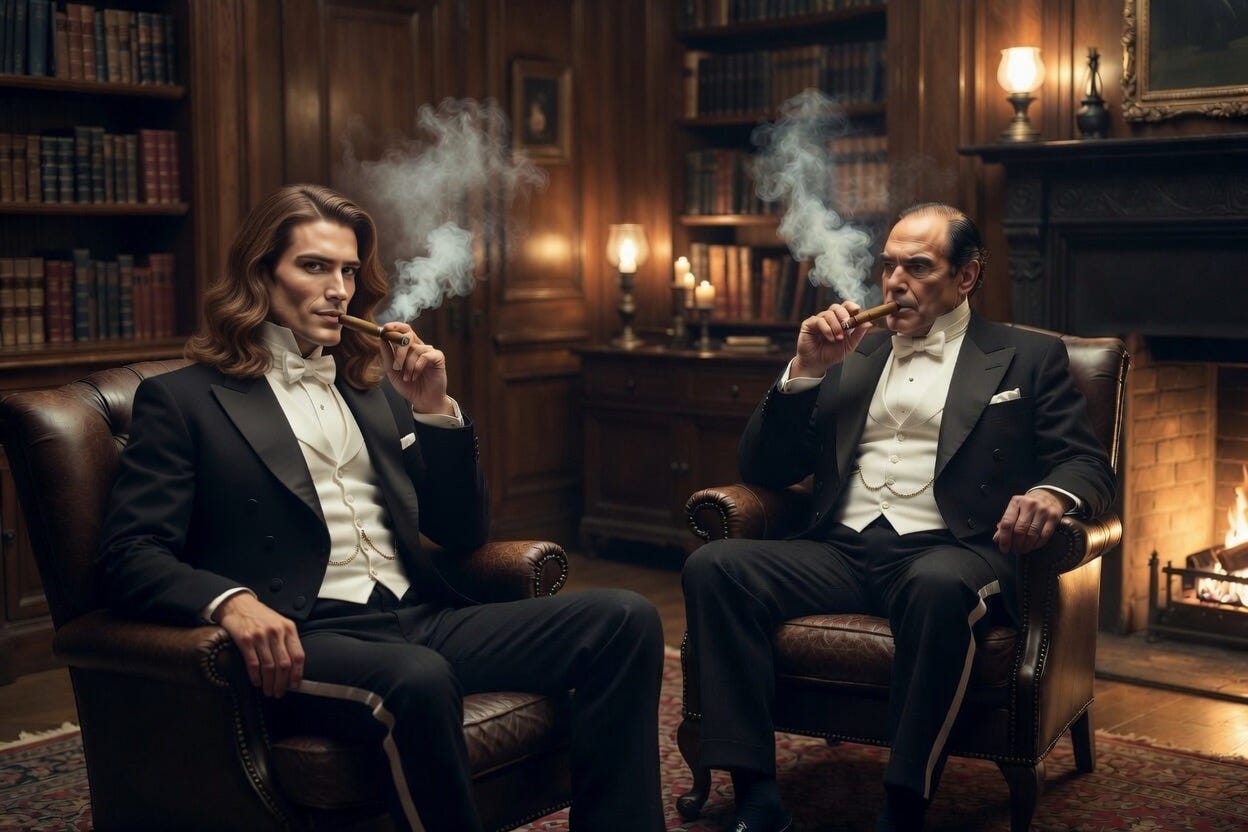
Downstairs, inside a smoke-filled parlour, Paul Stuart led Sir Clive to a quiet corner where two mahogany and leather club chairs stood empty. “Sit down, Urquhart,” he said producing a cigar. Aubrey clipped the end and lit it with an engraved, gold lighter. Handing a second smoke to the builder, the earl sat into a chair and crossed his long legs.
“Does Susanna enjoy the theatre?” he began casually. It was never good to rush into secret meetings. There was a method to gaining information of value, something that Paul had learnt from his Uncle James, a former espionage agent, who had spent many years in such work, before and after the Crimean War.
Sir Clive puffed on the cigar, his eyes rolling toward the painted ceiling of the salon. “These murals, my good Lord Aubrey, they are of operatic scenes, I think—a holdover perhaps from the early days of the playhouse. Rather risqué, no? Yes, Susanna loves the theatre, the opera, and even the music halls, though her own voice is more suited to private venues, if you get my meaning. She has a lovely mezzo, sweet and husky at times, but she could never fill a hall such as this, and certainly not Covent Garden. She often entertains at my humble soirées. One day, perhaps, you will attend a party at my home in Grosvenor Square, yes?”
Sir Clive loved including his exclusive address when referring to his three-storey mansion—built to his own specifications as a monument to greed, decorated with grotesque statuary and lewd fountains. Paul found the place detestable and vulgar, but if attending such parties kept Clive talking, then he would do so.
“Perhaps. That would be lovely—as is the lady Susanna. I look forward to hearing her sing. Thank you.”
Urquhart, born to a Scottish father and a French mother, had been raised in Paris, and his pattern of speech and accent often wandered from one nationality to the other. “Excellent! No doubt my small house is but a speck to one such as your Duchess Elizabeth, but I would hope to see her visit as well. She is so lovely! Such a divine form! So tiny a waist—and all natural at that. You are a lucky man, my friend Aubrey. Is your wedding date set?”
Paul refused to let this small man bait him, though his rude reference to Elizabeth’s all natural figure deserved eventual satisfaction. “We have not yet announced our engagement, as I am sure you know, Clive. It is an arrangement that goes back to our much younger days, but we are now adults, she and I. We shall announce when the time is right.”
The builder puffed out a long stream of smoke, which rose above his balding pate like a hazy halo. A curious picture, the earl thought. If an angel, then a fallen one, surely.
“Announce it soon, my friend. Now that the duchess has returned to England, she will draw men to her like flies to honey, and perhaps one lucky little fly will catch her eye, and you find your childhood arrangements have disappeared like so much smoke, eh?”
“Elizabeth is a beautiful woman. It is understandable that men are drawn to her,” the earl countered, hoping to derail the builder’s insinuations, but the little man had no intention of being so diverted from his point.
“Indeed. Many men’s eyes follow her, do they not? But you need not worry, Lord Aubrey. Marriage is but a contract, and such legal annoyances are meant to be broken, so no matter. Infidelity is a bulwark of peerage life, is it not?”
“Is it? If so, then you travel in different peerage circles than do I,” Stuart answered, gall rising at the back of his throat. “If you’ve something to say, then, perhaps, you’d best say it; otherwise, I shall return to Elizabeth.”
“She is safe, my friend. No need to worry—not here. Ah, but, I have much to tell you, so we leave behind our talk of women and weddings for another day, no? For now, I have this.”
He reached into the inner pocket of his tailcoat and withdrew a small, velvet bag. Leaning toward the earl, he held the bag in the air—dangling it, as if contemplating a change of mind, his beady eyes on the drawstrings of gold.
“Inside this little bag is a humble offering, so many would claim, but they would be wrong. These baubles, this shiny bit of stuff, comes from a source that is unimpeachable. Its contents are items which I know, my good Aubrey, you have seen before. You will recognise them. I expect you to have them thoroughly investigated, studied, and verified. And if this bag is all that I claim it to be, then perhaps my bank account will be reimbursed for what I have already paid for this shining bit of history. Is that not fair?”
Urquhart held the bag aloft, teasing it as a gift, testing Paul’s patience. The earl sat perfectly still, his cool blue eyes fixed on those of his adversary. Not once did he even glance at the bag. “If, Sir Clive, these baubles as you call them have any value to me, then speak plainly. Otherwise, enjoy your cigar,” he finished, starting to rise.
Urquhart’s black eyes narrowed, and he pondered his foe’s demeanor, his will. Laughing as if it had all been a great joke, he tossed the bag to Paul and spread his hands. “See? Am I not trusting? Examine the rings, and then, after you have satisfied yourself that all is genuine, send me a note by our mutual messenger. I am in no hurry. Your honour is well known in England, Lord Aubrey. And so is your lady’s.”
Paul wanted to bash the man’s skull open, but he remained calm and still, refusing to open the bag. He placed it inside the breast pocket of his dress coat, next to a small keepsake he kept always with him—a locket photograph of Elizabeth taken on her eighteenth birthday whilst in Paris. He cherished her, and he would love her until his last breath, but her honour must wait if Paul were to obtain all the proofs he needed to forever erase the dangers to her life.
“You will not be disappointed, Lord Aubrey. Not at all. I obtained the beautiful, jeweled rings from a companion whose close connexions tell me all that happens in the high offices of our fair city. When you have verified the gems, let me know, and I shall tell you how this pouch and its expensive contents came into his hands, and so into mine.”
Without one word further, Paul rose, leaving the builder to enjoy the cigar alone. Passing through the thick crowd of merchant men, bankers, and nobles, half-hearing their raucous jokes and brags of bedroom prowess, Paul left the salon behind and climbed the gold embellished staircase that led to his family’s private box. As he neared the velvet curtains that draped the entrance to the elegant interior, he noticed a strangely shaped, black shadow lingering near the door to a short wooden staircase, and thence to the backstage area.
It is but a shadow, cast by one of the large, fly-space lamps, surely, he thought. The dense shadow seemed to flicker, but then stood perfectly still, bent as if listening...and then he saw its red eyes—certainly no shadow then.
Paul advanced toward the monstrous shape, but as he neared the apparition, it completely disappeared! Stunned, the earl searched the area, even opening the backstage door to assure himself that his eyes had not misled him. No one was there, save a fly man, far on the opposite side of the gallery, working a series of ropes and pulleys that controlled scenery below.
The man must also have seen the earl, for his florid face jerked toward the door, and in a rather inebriated voice, he called out softly, “You’re not a’posed to be here, guv! Nobody backstage durin’ a show!”
Paul walked around the outer edges of the fly space, his tailcoat gathering dust as he worked his way along the slender walkway to the man’s position. Producing a sovereign, he asked plainly, “Who else has been here that didn’t belong, my good man?” A gin bottle peeked out from the old man’s belt, and Paul added a second sovereign to the first. “These two, golden brothers are yours, my friend. I only want a true answer. Who else was back here—just moments ago?”
The man’s face grew long and white. “Tweren’t no man,” he whispered tightly. “No man, but—but sumfing. Sumfing what never ought to be, guv. I tell you by the ‘eavens, it never ought to be!”
Paul gazed into the man’s pockmarked face, realising he had spoken truly, and he handed him the coins. “If ever you see it again, you are to tell me. Send word to Aubrey House and ask for me. I am Lord Aubrey.”
The man gulped and nodded. “I will, yer lordship. I rightly will.”
Returning to the hallway behind the boxes, Paul suddenly remembered the velvet bag. Removing it from his pocket, he untied the top and opened it in view of the dimly lit gas lamp. Upturning its contents into his left hand, three jeweled pieces fell into his palm. Two rings in a set: one a diamond band, whilst the other contained a flawless central diamond, flanked by a smaller pair of diamonds and two sapphires, set into a ring of fine gold. The last was a jeweled cross on a chain. All were known to him, just as the scoundrel Urquhart had promised; they had been worn by Patricia Stuart every day of her married life to her first husband, Elizabeth’s father, Connor Stuart. How had Sir Clive gained access to items surely collected by H-Division more than nine years earlier? Paul replaced the items into the bag and hid them once again within his pocket.
Deciding to say nothing to Elizabeth, Paul brushed the dust from his coat with his hands, hoping her observant mind would not notice or ask for an explanation. The less she knew, the better she would sleep. Better that he lose sleep than she. Parting the curtains, he found both women quiet.
“Sorry to be gone so long,” he whispered as he sat beside the duchess. “Sir Clive remained behind, Miss Morgan,” he said to Susanna. “Beth, you are pale. My fault, I fear. I should not have left you.”
“No, I’m just enjoying the play,” she lied. “May we leave soon, though? I’ve caught a chill, I think.”
“We may go now, darling, if you wish it. Miss Morgan, I shouldn’t like to leave you unattended. We shall wait until Sir Clive returns.”
Susanna laughed and tapped the earl’s upper arm. “My, you are muscular!” she said with a wink. “Oh, I’m just fine here on my own. In fact, I might even wander about, have a look to see who’s here.”
Aubrey kissed the American’s hand politely, noticing her seductive glance as he did so. “Then I shall say goodnight, Miss Morgan. Tell Clive that I shall contact him soon.”
He left with the duchess, and Susanna waved to the man in the opposite box. In a few moments, the tall man had joined her, and the pair entered an intense conversation.
Once at home, the earl and duchess sat quietly in the red room, a favourite drawing room for after dinner conversation at Queen Anne House. Miles served tea and brandy along with several light desserts, retreating once he’d made sure both his charges were comfortable.
“Thank you for bringing me home early, Paul. I was surprised that you spent so much time with Sir Clive, but I imagine it was business. He is quite rude, though. Don’t you think?”
“He’s a bounder, but yes, we had business to discuss. His manner toward you is beyond rude, darling, and I will have none of it. I as much as told him so.”
Elizabeth sat next to him, using her small hand to brush his long chestnut hair back from his soft blue eyes. “Yours is a great heart,” she said, kissing his cheek. “And I cherish it. I would not risk that heart for the world.”
He leaned into her embrace, letting his head fall against her shoulder, his hand in hers. “You are my world, Beth. My sole reason for being. I’ve loved you since you were born. Loved you at first with the innocence of a cousin, loved you later with the faltering devotion of a restless school boy, and now with the ardent passion of a man. I would walk through fire and back again if you asked it. And I would—I would…”
She kissed his forehead. “Do not think on it, my darling. Let us live for now. Forget any fears, any dangers, any secret lives from the past that rise up to haunt us. May we do that, Paul? Live only for this moment?”
“This moment, Beth?” He sat up, his blue eyes smoking into a deep grey hue as he drew her into his arms with a fire in his mind and body he could no longer hide. His lips touched hers for the first time in their adult lives, not with the sweet affection of a cousin, but as a lover. His muscular body wrapped around hers in a way she had never before experienced, and it was like disappearing into a raging inferno.
Elizabeth allowed him to take her this way, to make her his own—if only for that moment, but as his kisses grew hotter, she suddenly felt emotions stirring she’d never felt before, and it startled her. “Paul, no, please! Not like this,” she whispered huskily, pushing him away.
“I am sorry! I forget myself, Beth—forgive me! Please!” He looked like a wounded child now, pain and regret etched across his brow like a brand. “Oh, my darling Cousin, please, forgive me.”
She kissed his hands, her small mouth crimson with the rush of blood still pulsing in her ears. “Always, my dearest,” she assured him. “Always.”
“Marry me, Elizabeth. Now, tonight. Marry me! Let me protect you from all that awaits in the shadows of our lives. Please, let me be there night as well as day, to love you and keep you safe.”
She wanted to say yes. She knew she would eventually say yes, but somehow tonight she could not—the memory of St. Clair’s embrace and his kisses were still too fresh.
“I truly do love you, Paul. Love you now and will always love you. You are the Scottish knight of whom I dreamt as a child, and I long to know you as husband, too…but not now. Not yet. Please, may I have until Christmas? Then, I will accept your proposal. I promise. And we shall marry in the spring.”
He knew she meant it, but a great gathering shadow had taken root in his heart, and he wondered if the thing he’d seen at the theatre might not be some omen of dark days to come. He longed to run away with her—to whisk her away to some safe ground, to lock her up where he alone could reach her, but he knew she would never permit it. Yes, she feared what Trent and his cabal might try, but her brave heart would never allow him to risk all for her. He loved her even more for knowing it.
“I shall content my heart with that promise,” he told her, “but until that official day, when you publically proclaim your heart joined with mine, until that announcement at Christmas, will you not wear this?”
He withdrew a small, blue velvet box from his pocket. He’d carried it for weeks, hoping for the right moment to ask her, to see it fitted onto her slender finger. Now, he prayed, was the time.
He opened the box, revealing a brilliant blue diamond set into a band of platinum and gold. On either side of the flawless ten-carat blue, two companion diamonds of clearest white served as sentries to the magnificent centre stone. The duchess gasped at the ring’s remarkable beauty. Looking up, her eyes brimming with tears, her sweet mouth open as if to speak; she appeared suddenly struck mute. She bit her lip, her eyes dropping great tears onto her dress.
“Paul, oh, my precious Paul. How long have you been planning this?”
He hoped this meant that she accepted—even if only for their own private moment. “A month. Perhaps longer. I don’t know. I only know I saw this stone last time I was in Antwerp, and I knew it must be on your hand, and yours alone. You needn’t make any promises, Princess. Just wear it as a gift from your Scottish cousin.”
She sighed, knowing what accepting really meant, but she loved him so—and had for so very long—that she gave him her hand. “Perhaps, we should make certain that it fits,” she said, noting the look of hope in his handsome eyes.
He removed the ring from the box and slipped it easily onto her left hand, kissing her fingertips as he did so. “A perfect fit.”
She nodded. “A perfect fit, but then I would expect no less from you, Lord Aubrey. Kiss me now, and let us seal our private arrangement. I promise you, Paul; we will let the world know at Christmas.”
He kissed her, whispering into her ear. “At Christmas.”
But that day would never come—not as they hoped. Shadows had already set sights on the pair, and a tall man had just stepped onto the sands of Hampton-on-Sea, his grey eyes riveted on the great manor house a few miles from the seaside village, beyond the dark woods.
Will you continue writing another book? I have all of them. Seems like there should be another one coming with that ending on the train with the last one. Love the series!